Year 4 · Autumn term · Place value · Step 11
Year 4 Compare numbers to 10,000 worksheets with answers
Compare four-digit numbers with the symbols for less than, greater than and equal to, and put some in order. A free editable Word sheet with eight fluency and six reasoning questions. The answers follow the questions: the same sheet again with every answer in red.
Download the worksheets
Printing tip: the red answers are in the same file, after the questions. For pupils, print only the pages before the red answers (in Word, choose the pages in the print box). Keep the full file for marking.
Print on A4 portrait: every page carries the sheet twice, side by side, so you can cut down the middle and two pupils each get a half to stick in their books. Every question sits in its own box and pupils write their answers in their book. The answers follow the questions in the file: the same sheet again with every answer in red. It opens in Word, Google Docs, Pages and LibreOffice, so you can change numbers, delete questions or add your own. There is no scaffolded version of this step yet.
Not scaffolded sheet
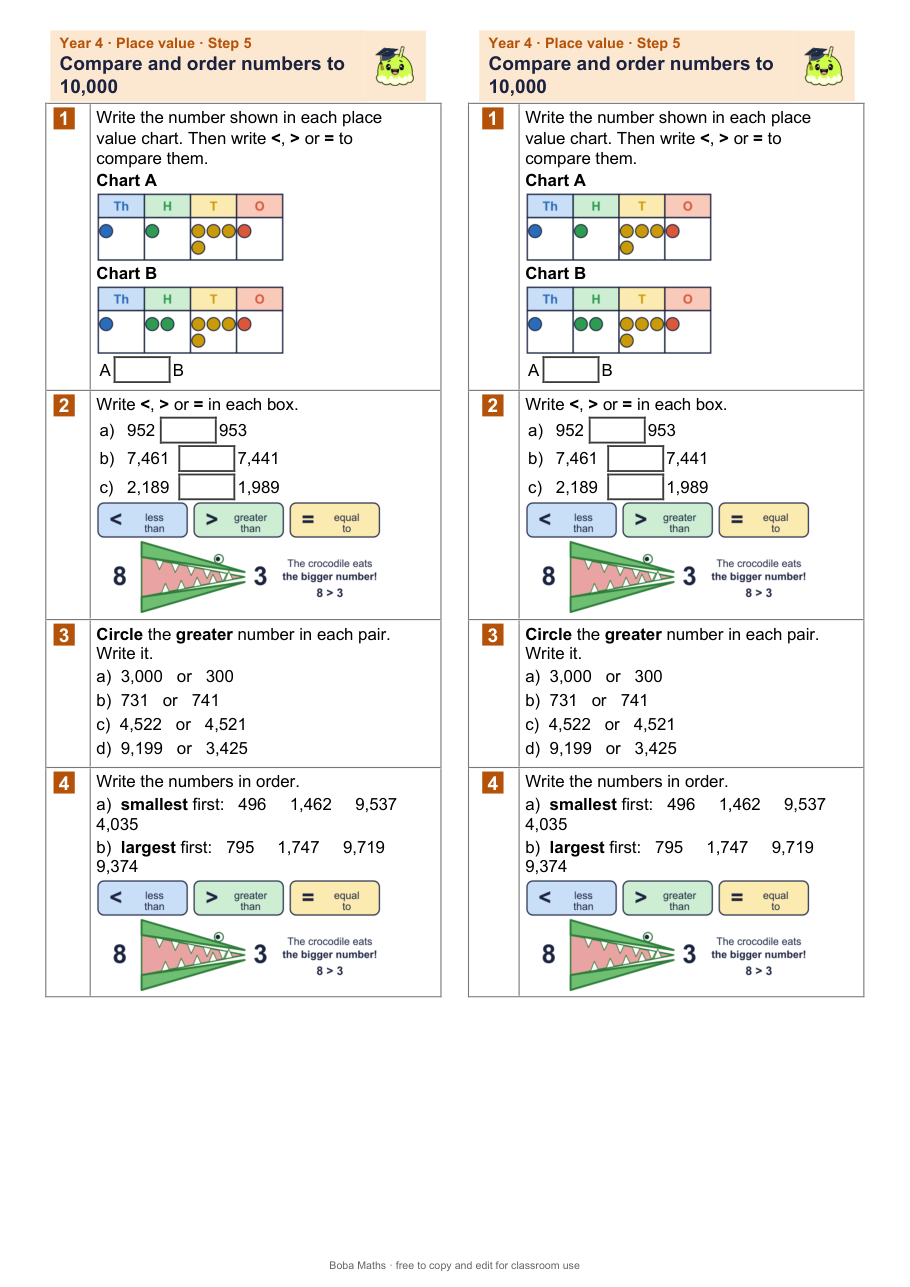
The same questions without the extra support. For pupils working at the expected standard: eight fluency questions first, then the reasoning questions.
Free lesson PowerPoint: Year 4 Compare numbers to 10,000
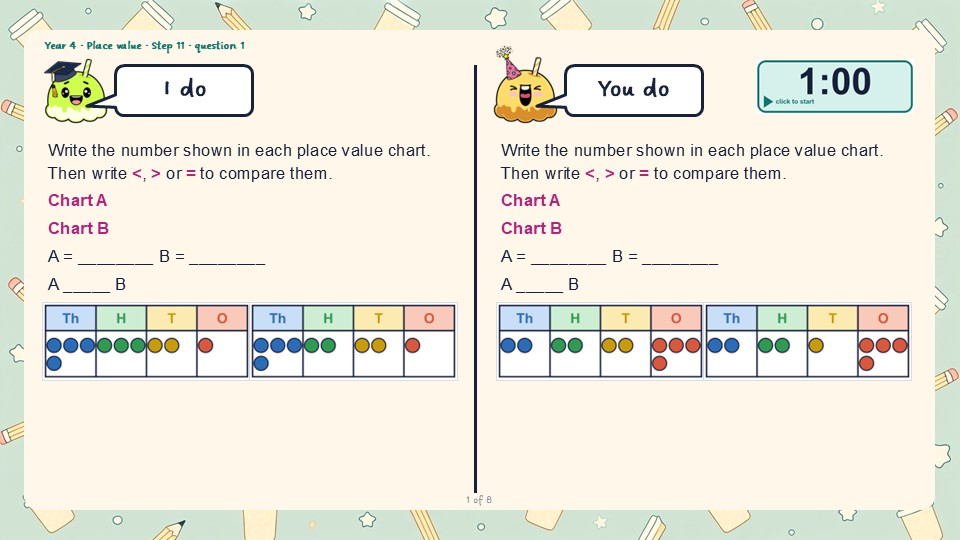
A ready-to-teach PowerPoint for this step, in the same style as the worksheets. Each slide pairs an “I do” problem (the teacher models it) with a “You do” problem of the same type with different numbers, laid out exactly the same on both sides, with a timer for the “You do” side. The questions get harder as the lesson goes on and match the worksheet without repeating its numbers.
Download the lesson PowerPoint (.pptx, 3.0 MB)
- 15 slides: a title slide with the Bobas at their desks, a four-question starter that revisits the previous lesson, learning objective and success criteria, key words, two teaching slides, 8 I do / You do slides, and a final “Independent application” slide with a 20 minute timer, the worksheet and a challenge.
- Answers arrive one click at a time on the same slide: first a hint for the “I do” problem, then its answer, then the answer to the “You do” problem. Answers are in red, and every slide has teacher notes.
- Countdown timers: each “You do” side has a countdown clip with digits and beeps, set to an estimate for that question (for example 1:30). Click it in slideshow mode to start it. They are short embedded videos, so they need PowerPoint, and the times are fixed in the file: ask for the lesson to be rebuilt if you want a different length.
- Animations: the answers, timers and bouncing Bobas use PowerPoint animations. Other programs, such as Google Slides or Keynote, may not play them: open the file in PowerPoint.
- Fonts: titles and information use the font Dreaming Outloud Pro, which is not included in the file. On a computer without it PowerPoint shows another font. The questions are in Arial so they look like test questions.
- The questions use the same types as this step's worksheet with different numbers, every answer was recomputed by a separate program, and every picture was checked against its numbers, but nobody has trialled the slides with a class yet. Please check the slides before you teach them.
Sample questions from this step
These are real questions from the first set of the sheet (two from the fluency page, two from the reasoning page). Open each one to see the answer.
- Write the number shown in each place value chart. Then write <, > or = to compare them.Chart AChart BA = ____ B = ____A ____ B
Show the answer
A = 1,141, B = 1,241; so A < B
- Write the numbers in order.a) smallest first: 496 1,462 9,537 4,035____b) largest first: 795 1,747 9,719 9,374____
Show the answer
496, 1,462, 4,035, 9,537; 9,719, 9,374, 1,747, 795
- I put these numbers in order, smallest first.862 1,412 7,729 6,944Is Boba correct? Circle yes or no.Circle yes or no.Explain how you know.
Show the answer
No; 7,729 is bigger than 6,944, so it should come after it. The numbers should be: 862, 1,412, 6,944, 7,729.
- Look at the two place value charts.a) Which chart shows the greater number? Write A or B. ____b) How much greater is it? ____
Show the answer
B; 99
What is on each sheet
- Fluency: eight questions that start easy and get harder, with the key skill of the step practised in different ways.
- Reasoning: questions with pictures, tables and number lines (spot the mistake, true or false and explain, puzzles with one answer, an open-ended task).
- Answers in the same file: the sheet again with every answer in red, so there is only one file to download.
- Boba characters give the instructions in speech bubbles. They are decoration only.
Why one set of questions?
- Everyone works on the same content, and support comes from scaffolds instead of different, easier tasks. This follows the mastery approach described by the NCETM and the thinking in Ofsted's 2021 mathematics research review.
- Worked examples and visual representations lighten the load for pupils who need it, as the Education Endowment Foundation describes.